The Ocean We So Love
Interactive Installation,
built with Arduino, Touchdesigner, Garageband


The Ocean We So Love is a figurative expression that highlights the challenges our ocean faces. Through acknowledging the charms of the material world- its ephemerality and expendability, this multimedia interactive installation wants to reveal the fraught intersection between man and our ocean bodies. The debris around is often drowned out and diluted by Mother Nature herself and the ocean is threatened by this chemically inert material. Discovering waste for waste itself, participants are brought through an experience to understand that marine debris goes nowhere and often ends up as unusable waste. By rocking the structure, changes the environment audibly and visually to emotionally invoke a realization of how catastrophic this problem is and how it should no longer be dismissed.


Material Research: Marine Debris
Material research played a foundational role in shaping the project. Marine debris was collected through beach clean-ups and Kayak “N” Klean sessions in Singapore’s coastal and mangrove areas. I made a deliberate decision to minimally treat the materials, cleaning them only enough to dry while preserving barnacles and the grime. Barnacles, in particular, acted as unintended markers of time, indicating how long an object had remained submerged. I wanted my audience to understand that plastic goes beyond being just something visually polluting but instead something structurally embedded within marine ecosystems.

Sorting out the trash collected from a Kayak N Klean session

Drying in the state they were found
The collection process also revealed the transboundary nature of marine debris. Foreign-priced bottles and chewing gum packaging, which is illegal in Singapore, highlighted how plastic pollution cannot be easily attributed to individual behaviour or national responsibility.


Chewing Gum packaging found during beach cleanup

Cocacola bottle found with stated price of 2.80 Ringgit (Malaysian Currency)
Form Experiments
Initial formal experiments explored mechanised wave-like movement using motors and wheels. These prototypes took the form of a rectangular cage that rolled back and forth under motor control. While the system successfully produced rhythmic motion, it quickly revealed structural limitations.
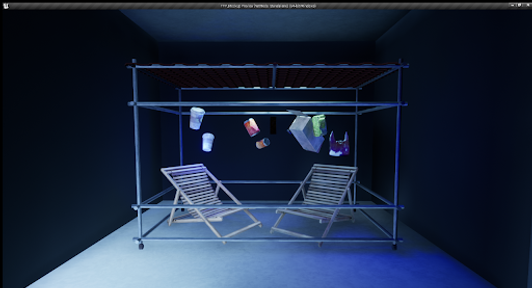
Initial render of structure prototype with sitting under

Initial prototype with space under to accommodate an audience
The mechanical components struggled under the weight of the structure and debris. More importantly, automation positioned participants as passive observers rather than contributors. But I wanted a piece that required physical participation.

Device attached to motor, using gear and gear rack to probe structure movement
Structural Shift: The Cradle Form
The project evolved into a human-powered structure inspired by the form of a boat. The form also introduced layered associations with vessels, and cargo. This design allowed the structure to rock forward and backward through participants' interaction.


While brainstorming on the theme of rocking and movement of waves, this cradle inspired form came along.
I originally wanted to fabricate a curved plane,
but it was too expensive.
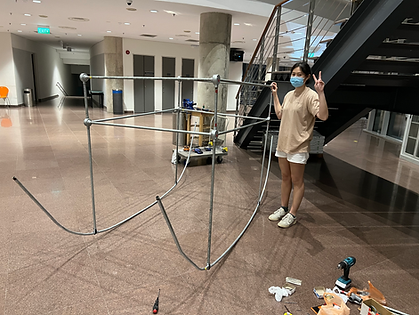
Developing the structure involved extensive material iteration. I needed help curving the wire without kinking the conduit pipes and first few attempts to join these curved pipes using 3D-printed connectors failed under load, breaking during stress tests. These breakdowns provided immediate feedback about weight distribution and material limits.


Render of connector
Failed attempt to use the printed connector
In response, I replaced single-point connectors with multiple metal supports that distributed the structural load more effectively.


DIY connector using metal steel bands and hose clamp
Digital Visuals
Hoping to bring attention to the state of marine trash and to lead people to taking a closer look at the trash around us, I incorporated photos I took on my beach scavenging trips into my set-up. This documentation was meant to alert those who are not exposed, the state of the trash when found.
The first rendition tried to corporate 3D water with 2D images. The water would flow to either end of the screen according to the rocking of the structure, via the readings of an accelerometer. The water would flow to reveal stacking images under it, representing the accumulation of trash in our oceans.
_HEIC.png)
Accelerometer placed
on top of cradle structure
Graphics rendered and flow according to accelerometer readings,
revealing the trash archival photos beneath
https://youtu.be/-EWS9Yp-Qlk?si=hAcBnqgLGPC1K9Uq
User testing with initial graphics
Many commented that the surface looked much like oil, which had potential to be linked to pollution, but I personally felt that it was an additional layer to the main message I was trying to express. Hence, I moved away from revealing the images through this method and brainstormed for another style.
The final imagery was eventually settled to take on a cleaner and minimalistic approach, allowing the focus to be on the photographed images. Before any rocking of the cradle, it sees the images floating in 3D space and moves according to the audio track. The movement of the images are in-sync with the waves layer of the audio which imitates the movement of trash in real life waters. It is manipulated on the X, and Z axis using TouchDesigner, continuing to re-emphasise the repetitive moment in our trash in the ocean. Rocking of the cradle will cause the screen to move through the documented photographs that are randomly laid out in the 3d visualisation.
Final imagery before rocking cradle structure
Final imagery while rocking cradle structure
Spatial Design
The surrounding space was deliberately designed to avoid romanticised ocean imagery. Industrial materials, concrete textures, and controlled lighting created a cold, utilitarian environment. Shadows cast by suspended debris animate the walls as the structure moves, immersing participants within the system and making their physical presence visible.
Setting up the space

Mock-Up render of setup
Interaction instructions were kept minimal, encouraging discovery through engagement rather than explanation.

Mock-Up render of instruction placard
Reflection
With The Ocean We So Love, I wanted participants to discover waste for waste itself, to be confronted with the fact that the material world is made to be disposed of and replaced rather than recycled. Rather than aestheticising debris or transforming it into something new, I was interested in amplifying the discomfort of recognising these materials for what they are, and in extending the time participants spent with that realisation.
Throughout the process, I often questioned whether the work was carrying too many layers of association at once. The scale of the final structure also introduced its own challenges. I realised that participants were more hesitant to interact with an object that matched their own physical size. With more time and resources, I would have preferred to build two smaller structures rather than a single large one, allowing for more approachable points of entry.

Mock-Up render of 2 smaller cradles version
Mid-point experimentation to make a smaller version
Despite these uncertainties, the process itself became one of the most valuable aspects of the project. Conversations with participants during testing, as well as informal input from friends who contributed ideas along the way, shaped the work in ways I could not have anticipated alone. The project ultimately became less about resolving a problem and more about staying with it.